How to Select the Right Ultrasonic Transducer
Checkline’s ultrasonic transducers are available in different frequencies, damping levels and probe characteristics to suit a wide range of applications. Choosing the right transducer ensures accurate measurements depending on the material type, coating, and thickness range.
Transducer Characteristics & Damping
Standard Probes: Ideal for Pulse-Echo measurements on uncoated materials, metallic coatings, or very thin paint layers. These probes offer good penetration and are suitable for general-purpose use.
Composite Probes: Better suited for softer or less uniform materials. They provide a wider bandwidth with improved resolution and detail, while still maintaining reasonable penetration.
HD Probes (High Damping): Designed for Echo-Echo (through coating) and Pulse-Echo measurements. Echo-Echo mode is used to eliminate coating thickness from the reading and is effective when wall thickness is above 2.5 mm and coating is below 1.0 mm.
CT Probes: High-damped transducers designed specifically for the TI-CMX Series to measure wall thickness, coating thickness, or both.
CT probes support:
- Coating measurements: Up to 2.5 mm
- Echo-Echo measurements: Require a wall thickness > 2.5 mm
- Echo-Echo-Verify: (Only on compatible models) Require a wall thickness > 1.25 mm
Transducer Frequency Guide
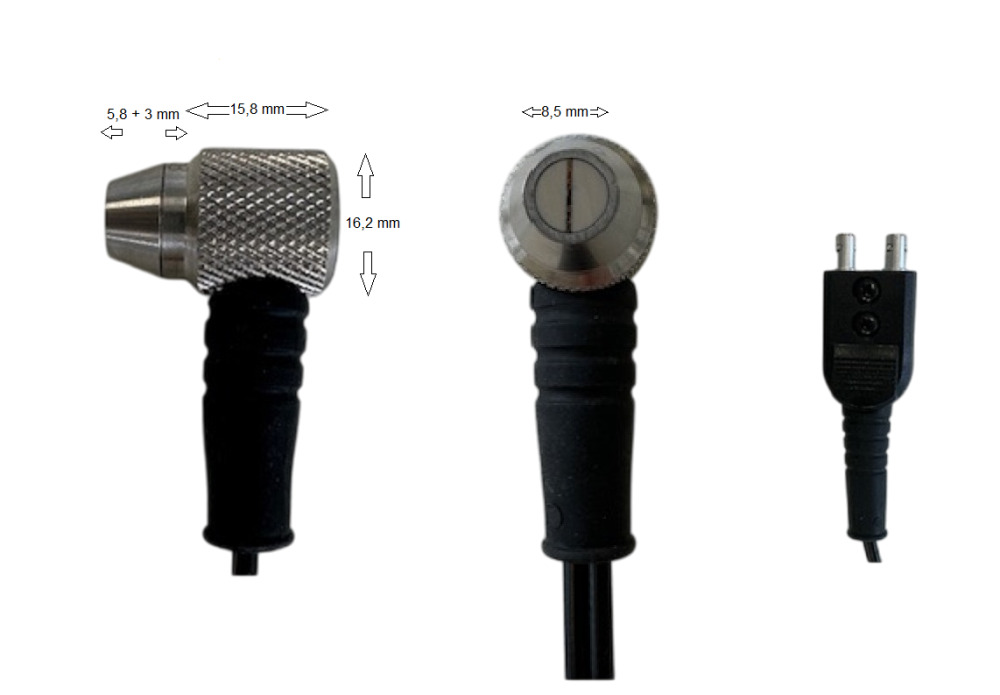
3/16” dual-element probes are available in frequencies ranging from 5 MHz to 10 MHz. Selecting the right frequency depends on your inspection depth and resolution needs:
- Low Frequencies (1–2.25 MHz): Provide deeper penetration for thick or alternative materials. Less resolution and larger dead zone—less suitable for thin walls.
- Mid Frequencies (3.5–5 MHz): Balance between penetration and resolution. Versatile for most standard applications.
- High Frequencies (7.5–10 MHz): Deliver greater resolution with shallower penetration. Best suited for thin materials and fine measurements.
Refer to the transducer selection table below to find the best match based on material type, surface condition, and measurement range.