
- Home
- Selection Guides
- Flaw Detection (NDT)
Flaw Detection (NDT)
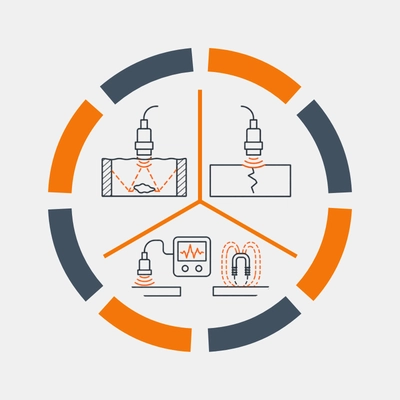
Flaw detection covers a family of methods — ultrasonic testing, magnetic particle, penetrant, eddy current and radiography — and each is matched to a particular flaw type and access condition under its own standard, so the opening question is which method suits the defect that concerns you. Where the answer is ultrasonic, the choice that follows is a focused one: a compact range of portable ultrasonic flaw detectors, the same instrument family that also gauges remaining wall thickness on one-sided access. If ultrasonic is the right fit for your flaw and your access, the guide below names the detector to reach for.
1. Measurement Contexts
- Ultrasonic Flaw Detection when you need to find and size internal defects in welds, forgings, castings, plate or in-service components from one accessible side, with the probe, calibration and sizing setup matched to the inspection at hand.
Where the same one-sided ultrasonic access is being used to gauge remaining wall on a corroded pipe, tank or vessel rather than to find and size a flaw, that is a thickness decision driven by access, and it continues under Wall Thickness Measurement.
2. Related Knowledge Resources
Pulse-echo theory, weld-inspection practice and flaw-sizing methods sit behind these instruments; Flaw Detection (NDT) is where that groundwork is explained.
