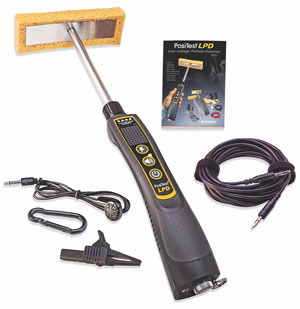
Low Voltage Holiday Detector for Coatings on Metal and Concrete
The PosiTest LPD Low Voltage Pinhole Detector from DeFelsko is designed to detect holidays, pinholes and other discontinuities in non-conductive coatings applied over metal and concrete substrates. Compact, ergonomic and easy to operate, it provides a safe and reliable solution for coating inspection up to 500 µm / 20 mils.
The PosiTest LPD uses the wet sponge method to locate coating defects that may expose the substrate and lead to corrosion, coating failure or reduced service life.
Compared with high-voltage spark testers, low-voltage detectors offer a safer, simpler and more cost-effective method for inspecting thin protective coatings without unnecessarily damaging the coating or exposing the operator to very high voltages.
Why Pinhole Detection is Important
Protective coatings are applied to prevent corrosion, chemical attack and premature substrate degradation. Even very small coating defects can expose the underlying substrate and become starting points for corrosion.
The PosiTest LPD helps inspectors verify coating continuity after application, especially in applications where coating performance is critical or corrosion is difficult to monitor.
Typical applications include:
How the PosiTest LPD Works
The PosiTest LPD operates by passing a moistened sponge over a non-conductive coating applied to a conductive substrate.
When the coating is intact, current cannot pass through the coating. If the sponge contacts a defect such as a pinhole, crack or holiday, current flows through the opening to the substrate, completing the circuit. The instrument then alerts the inspector with audible and visible alarms.
This makes the PosiTest LPD ideal for detecting hidden defects that may not be visible during a visual coating inspection.
How does a low-voltage pinhole detector measure coatings on concrete?
When measuring coating thickness, concrete is not considered a ‘conductive’ substrate, as it is much less conductive than metal. However, concrete is still slightly conductive, and can carry enough current to allow low‐voltage pinhole detectors to function. Therefore, for the purposes of low‐voltage pinhole detection, concrete is considered a ‘conductive’ substrate.
The challenge when conducting low‐voltage pinhole testing on concrete is to ensure the instrument is properly grounded. If there is exposed rebar or metal protruding from the concrete, this is the easiest solution. An alternative is to drive a metal rod (or piece of rebar) into the ground nearby the concrete to at least the depth of the slab, relying on the earth to conduct the electric current between the rod and the slab.
Need assistance? Contact us and one of our experts will help you choose the right tool for your application.
The PosiTest LPD Basic Kit includes everything required for detecting pinholes using a rectangular sponge wand.
Includes:

Model: LPDKITB
The PosiTest LPD Complete Kit includes all contents of the Basic Kit, plus adaptable sponge hardware and extension accessories for more test configurations.
Additional contents include:
Adaptable Sponge Hardware

Extension Accessories
Model: LPDKITC
| Voltage: | 9V ± 5%(90k) / 67.5V ± 5% (80k) / 67.5V ± 5% (90k) / 90V ± 5%(400k) |
| Sensitivity: | 90k ± 3% / 80k ± 3% / 90k ± 3% / 400k ± 3% |
| Thickness Range: | 0 – 500 µm (0 – 20 mils) |
| Temperature Range: | -10 – 50 °C (14 – 122 °F) |
| Power | 3x AAA Battery |
| Battery Life: | > 150 hrs, depending on battery type |
| Housing: | Weatherproof, dustproof and shockproof; meets or exceeds IP65 |
| Dimensions: | 27 x 6 x 5.5 cm (10.6" x 2.3" x 2.1") without wand |
| Weight: | 180 g (6.4 oz.) without batteries |
| Certification: | Long Form Certificate of Calibration included |
| Standards: | Conforms to ISO 14654/29601/8289-A, ASTM G62/G6/D5162, BS7793-2, NACE TM0384, SP0188, AS3894.2, JIS K 6766 |
| Warranty: | Two year |