Material Velocity: The speed at which sound waves travel through a material. Each material has its own velocity. The gauge calculates thickness by multiplying the velocity by the measured travel time and dividing the result by two. Calibration involves determining and setting the correct sound velocity for the material.
Since material velocity changes with temperature, it is important to calibrate the gauge as close as possible to the actual measurement temperature.
Pulse-Echo Measurements: In this mode, the transducer emits an ultrasonic signal that travels through the material until it reflects from the back wall. The echo is then received by the transducer and the travel time is measured.
When a coating is present, the total thickness (coating + base material) is measured because the time is taken from the transducer to the back wall, including everything in between. Echo-Echo Measurements: Measures the time between two successive back-wall echoes, effectively ignoring the coating and providing a true base material thickness. Echo-Echo measurements require a high-damping probe and are subject to minimum and maximum thickness limitations compared to Pulse-Echo mode. | 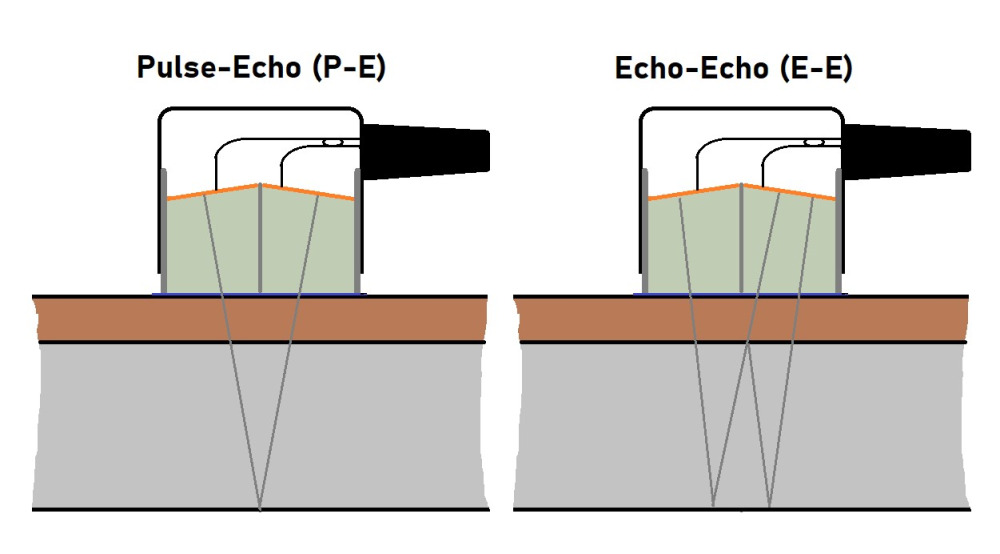 |
Scan Bar Display: A linear graphic bar that shows variations in thickness readings. The scale range can be adjusted by the user, making it ideal for detecting small changes in material thickness.
B-Scan Display: Provides a two-dimensional cross-sectional view of thickness while scanning a surface, creating a graphical map of the material profile measured from one side.
High-Speed Scan Mode: Enables scanning across larger areas of test material while maintaining reliable thickness representation. Offers up to 140 measurements per second with a display refresh rate of 25 Hz.
Limit Alarm Mode: Allows users to define Hi/Lo thresholds to verify that a material remains within the required thickness range. Audible and visual alerts are triggered when measurements fall outside set limits.
Adjustable Gain: The amplification of return echoes can be set manually or via Automatic Gain Control (AGC), making it easier to obtain accurate readings in materials that are more difficult to measure.