Material velocity: Is the speed sound waves travel through a material. Every material has its own velocity, the gauge multiplies the velocity with the measured time and divides it in two to determine the thickness. Calibrating the material means determining and setting the correct velocity for a material.
- As the material velocity changes with temperature it is important to determine the material velocity close to the temperature you are planning to measure.
Pulse - Echo measurements: Measurement mode where a transducer sends an ultrasonic signal through the material until it bounces back from the back-wall. The echo is received by the transducer and the travel time is measured.
If the material is coated the coating will be included in the wall thickness as the measurement id between the transducer and the back-wall measuring everything in between. Echo - Echo measurements: Measures the time between the first and second echo, this eliminates the coating as it only measures the base wall material. Echo - Echo measurements require a high dampening probe and there are limitations to the minimum and maximum wall thickness compared to Pulse - Echo measurements. | 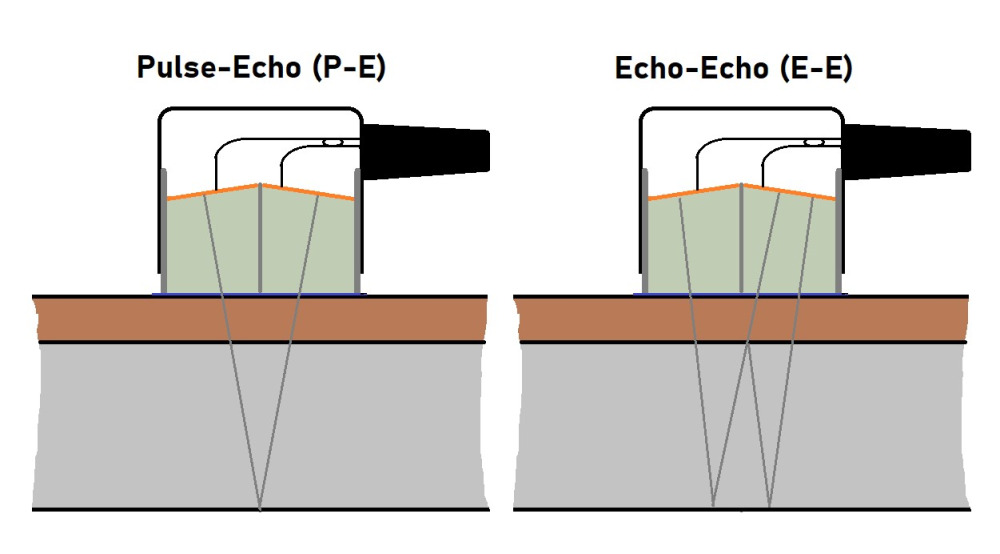 |
Scan Bar Display: A linear graphic line graphically showing changes in thickness readings. The scale range is user adjustable by the user making it ideal for observing tiny variations in material thicknesses.
B-Scan display: Shows a cross sectional 2D block view of the thickness when scanning a surface, providing a graphical map of the material thickness measured from one side.
A-Scan Display: Shows the sine wave created by the reflection of the sound. available in full wave or rectified set to a positive or negative view. A scan is only available on the TI-MVX model.
High Speed Scan Mode: Allows for scanning larger areas on a given test material, while still offering reasonable representation of thickness over the area scanned. With a maximum measurement frequency of 140 Hz and a screen refresh rate of 25 times per second.
Limit alarm mode: Sets an upper Hi/Lo lower range, used to verify a material is within a defined thickness range. An audible and/or visual signal can be given when a measurement exceeds a set limit.
Differential Mode: The option to set a nominal value, according to what the expected thickness should be, the display shows the +/- difference from the nominal value entered.
Adjustable gain: The gain, or amplification of the return echoes, can be adjusted manually or automatic (AGC) making it easier to create a good measurement in materials that are more difficult to measure.
Gates: A Gate is an adjustable marker in the timeline of a measurement used to evaluate specific parts of the echo signal from the material being tested. It helps to focus on an area and skip false echo's that disrupt the measurement The TI-M Series are equipped with up to 2 gates that can be fine-tuned to accommodate a variety of applications.