Material Velocity (Material Calibration): The speed at which sound waves travel through a given material. Each material has a specific velocity, which the gauge uses to calculate thickness by multiplying the velocity by the measured time and dividing the result by two. Accurate calibration requires setting the correct sound velocity for the test material. Since velocity varies with temperature, it is important to calibrate the gauge at or near the temperature of the measurement environment.
Pulse-Echo Measurements: In this mode, the transducer emits an ultrasonic pulse that reflects off the back wall of the material and returns. The time delay is used to calculate the total thickness—from the probe to the far wall.
When coatings are present, the total thickness (coating + base material) is measured. Because most coatings have a much lower sound velocity (often less than 50% of the base material), thicker coatings can significantly affect accuracy.
Direct-contact transducers also have a larger near-surface dead zone, reducing precision in thin-wall applications. Echo-Echo Measurements: This mode measures the time between two backwall echoes, excluding the coating layer. It provides a more accurate base material reading when coatings are present. Echo-Echo requires a high-damping transducer and has a reduced minimum and maximum measurable wall thickness compared to Pulse-Echo mode. | 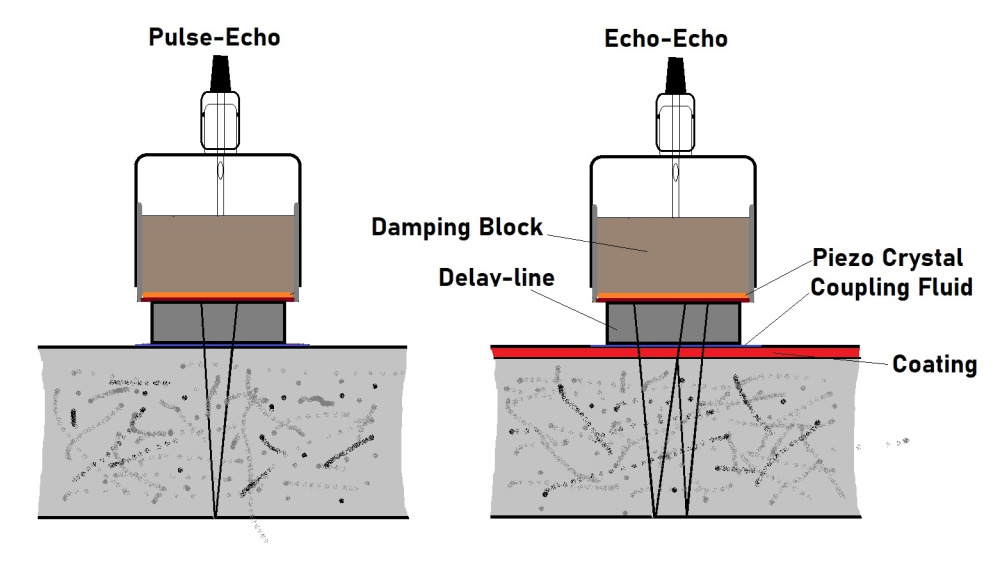 |
High-Speed Scan Mode: Enables rapid scanning across large areas with up to 140 measurements per second. The display refreshes at 25 Hz, making it easier to detect minimum thickness points quickly and efficiently.
Limit Alarm Mode: Allows operators to set high and low threshold limits, providing visual and audible alerts when measurements fall outside acceptable ranges. Ideal for fast quality control checks.
Differential Mode: Displays the deviation from a user-defined nominal value. This feature is essential for monitoring manufacturing tolerances and identifying material loss or corrosion.
Adjustable Gain: The HPX DLP offers flexible signal amplification via Manual Gain, Automatic Gain Control (AGC), and Time Dependent Gain (TDG), ensuring reliable echo visibility across different materials and wall thicknesses.
Time Dependent Gain (TDG): In Echo-Echo or Echo-Echo-Verify modes, echo amplitudes naturally decay over time. TDG compensates for this by gradually increasing gain, maintaining consistent echo visibility and improving reading accuracy.
Gates: A gate is an adjustable marker along the measurement timeline used to evaluate specific parts of the echo signal from the material being tested. It helps to focus on relevant echoes and reject false signals that disrupt measurement. The HPX DLP is equipped with up to three gates that can be fine-tuned to support a wide range of applications.