Material velocity (Material Calibration): The speed at which sound waves travel through a given material. Each material has its own characteristic velocity. The gauge calculates thickness by multiplying the velocity by the measured time and dividing the result by two. Calibrating the gauge involves setting the correct velocity for the material being tested. Since material velocity changes with temperature, it is important to calibrate close to the temperature at which measurements will be taken.
Pulse-Echo measurements: In this mode, the transducer sends an ultrasonic pulse through the material, which reflects off the back wall and returns to the transducer. The gauge calculates the thickness based on the time it takes for the echo to return.
If the material has a coating, the measurement includes both the coating and the base material, as the time is measured from the transducer to the back wall. As most coatings have a lower material velocity (about 50%) a (heavy) coating will have an effect on the accuracy of a Pulse-Echo measurement. Echo-Echo measurements: This mode measures the time between two successive echoes, effectively removing the coating layer from the measurement. Only the thickness of the base material is recorded making it a more accurate measurement on coated materials. Echo-Echo requires a high-damping transducer and has more limitations in terms of minimum and maximum measurable thickness compared to Pulse-Echo mode. | 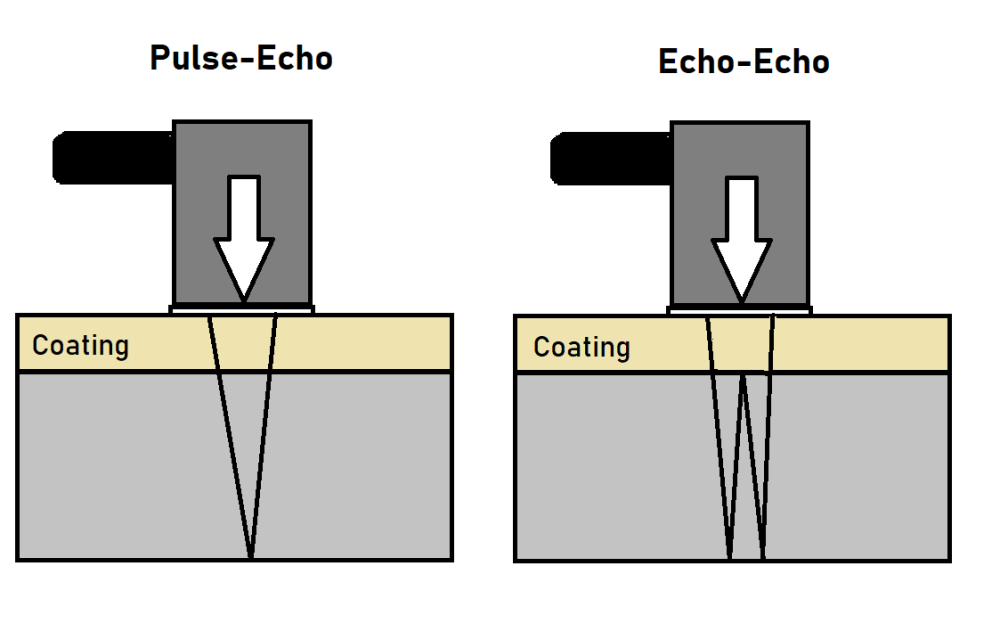 |
High-Speed Scan Mode: Enables quick scanning across larger surfaces, providing a reliable representation of material thickness over the scanned area. The system can operate at up to 140 measurements per second, with a display refresh rate of 25 Hz.
Limit Alarm Mode: Allows the user to set high and low thickness thresholds. An audible and/or visual alert is triggered if the measurement falls outside the defined range.
Differential Mode: Displays the deviation (+/-) from a user-defined nominal value. This helps monitor whether the measured material thickness is within the expected tolerance.
Velocity Gauge (VX): Converts the instrument into a dedicated velocity gauge, displaying readings in metres per second (m/s). This function is useful for basic nodularity testing, where sound velocity is used as an indirect indicator of density, hardness, or material strength.
Adjustable Gain: In models where available, the signal gain (amplification) can be adjusted to improve echo detection in challenging materials or measurement conditions.